

Welcome To Your
Private Diamond & Jewellery Space
Sign in to continue your HIVA experience.
“A world of diamonds, crafted around you.”
Know More. Choose Better.
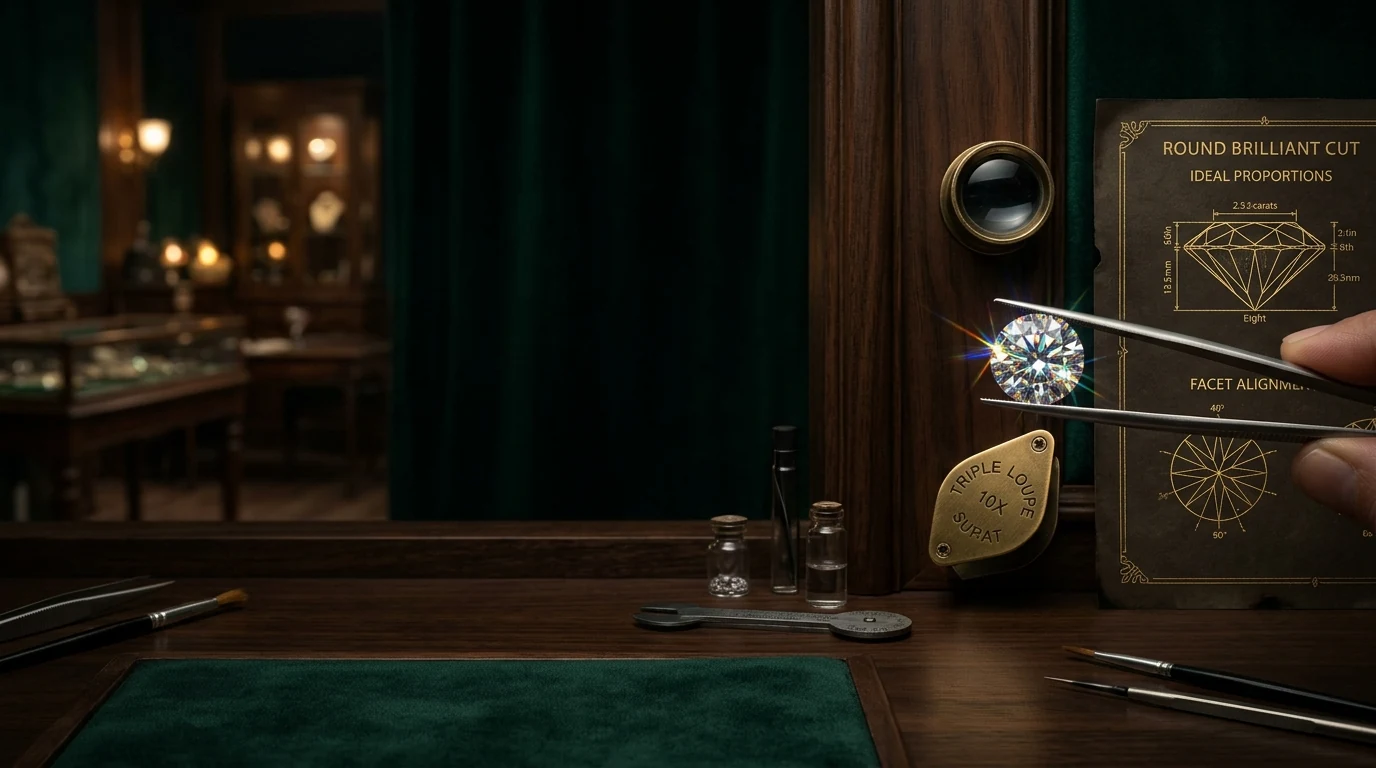
Discover everything you need to know about diamonds — from their elemental origin and characteristics to 4Cs grading, certification, craftsmanship, and lifelong care.
Every exquisite solitaire begins as an uncut rough gem — forged over billions of years or grown as atomic single-crystal seeds in CVD plasma chambers.
A diamond is the only gemstone composed of a single chemical element: pure crystallized carbon. Locked in an indestructible tetrahedral crystal lattice, it represents nature’s ultimate synthesis of extreme atomic hardness, supreme durability, and breathtaking optical brilliance.
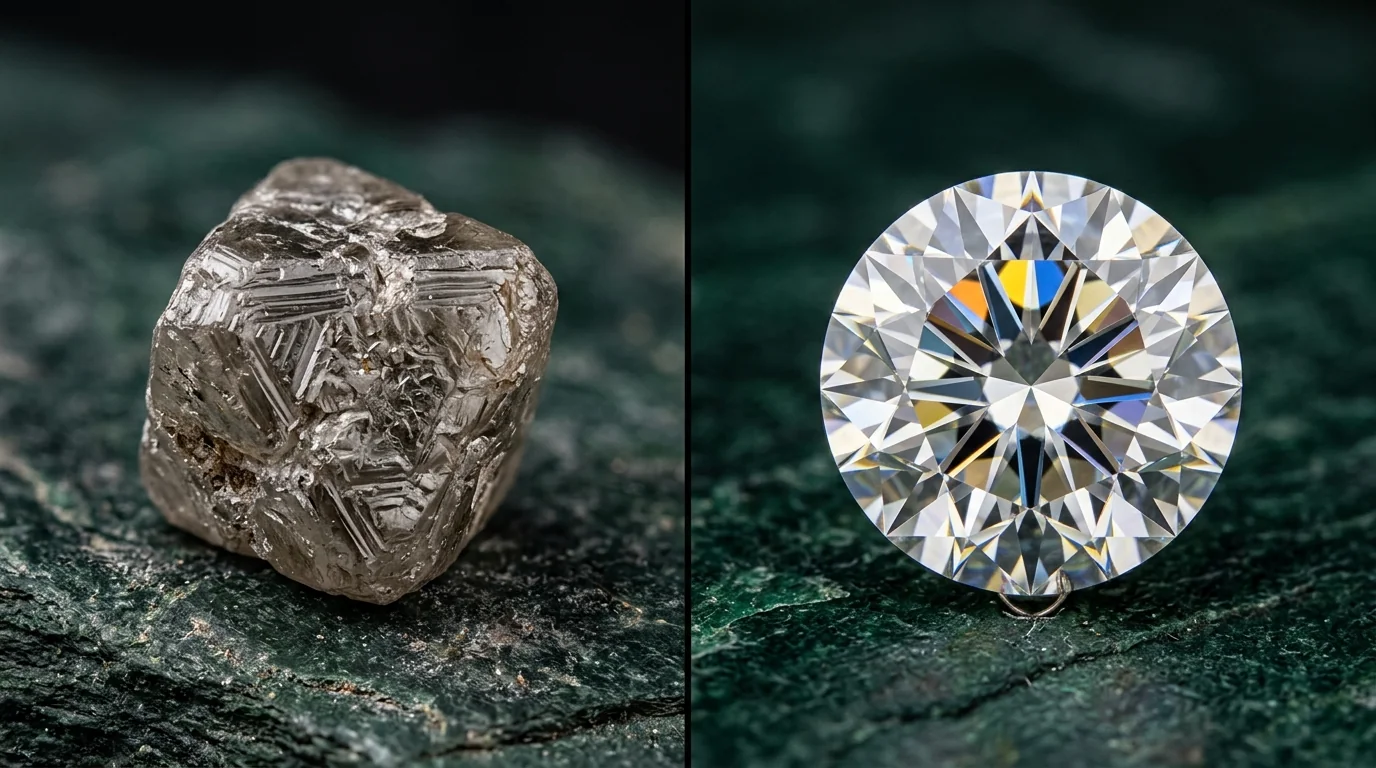
Atelier Insight: A rough diamond emerges from the earth or growth reactor as an unpolished, frosty octahedral crystal. It requires precision laser mapping and master faceting in Surat to unleash its internal fire.
Light travels through vacuum at 300,000 km/s, but slows dramatically to just 124,000 km/s inside a diamond due to its dense refractive index (2.417). When facets are cut at precise mathematical angles, incoming light bounces inside like a hall of mirrors and exits back through the top as brilliant white return (*brilliance*) and split rainbow flashes (*fire*).
Every carbon atom in a diamond is covalently bonded to four adjacent carbon atoms at 109.5° angles, forming an unyielding three-dimensional matrix. This spatial symmetry leaves zero unshared valence electrons, making diamond an electrical insulator with phenomenal structural integrity.
While ideal diamonds are 100% colorless pure carbon, microscopic trace elements create rare hues: nitrogen imparts pale yellow or brown tones, boron absorbs red to produce sky blue, while mechanical lattice shear under tectonic stress bends light into vivid pinks and reds.
Mined diamonds formed 1 to 3.3 billion years ago deep in the Earth’s mantle and were propelled upward by supersonic kimberlite volcanic eruptions. Today, modern Surat laboratories recreate these exact atomic conditions in CVD reactors and HPHT presses in weeks.
Formulated by the Gemological Institute of America (GIA) and adopted globally by IGI and HRD, the 4Cs — Cut, Colour, Clarity, and Carat — represent the universal language of diamond quality, grading, and valuation.
Cut is universally regarded by master diamond cutters as the most critical of the 4Cs. While nature dictates a rough diamond's colour and clarity, its cut is the only factor completely crafted by human hand. A poorly cut stone will look lifeless and dark, even with D color and Flawless clarity.
Light strikes pavilion facets at low angles and leaks straight out through the bottom. Creates a watery, dull “fisheye” effect.
Light reflects internally across opposite pavilion facets and erupts straight back through the crown into the viewer's eye with maximum fire.
Diamond is cut too tall to retain carat weight; light escapes through the side walls, creating a dark, shadow-centered “nailhead” center.
The brightness created by the combination of all white light reflections from the surface and interior of the polished diamond.
The dispersion of white light into vivid spectral rainbow flashes (red, orange, green, blue) as light exits angled crown facets.
The flashes of light and dark contrast produced when the diamond, light source, or observer moves. Balanced facet sizing prevents darkness.
A diamond's shape is its physical outline and facet architecture. From the classic fire of the Round Brilliant to the clean vintage symmetry of the Emerald cut, each shape possesses its own optical personality and finger presence.
The Benchmark of Unrivaled Fire & Sparkle
Engineered with 360-degree rotational symmetry to maximize light return, fire, and scintillation.
Universal; looks sensational in classic 4-prong or 6-prong solitaires, halos, and three-stone rings.
Always prioritize Cut grade over Colour or Clarity. An Ideal Cut round hides minor inclusions naturally.
A standard Round Brilliant diamond consists of precisely 57 or 58 facets engineered with exact mathematical proportions. Click any anatomical zone below to discover how each section controls structural integrity and light return.
The largest flat facet at the very top of the diamond, functioning as the primary optical window.
Allows maximum ambient light to enter the stone and serves as the primary exit pane for intense white light brilliance.
Location: Uppermost flat facet on the diamond crown. Deviating from the optimal range diminishes brilliance and can compromise secure ring mounting.
A balanced, factual gemological comparison. Under international law and gemological consensus (FTC, GIA, IGI), lab-grown diamonds are real diamonds — sharing the identical physical, chemical, and optical DNA of mined diamonds, differentiated solely by their origin.
Forged billions of years ago under intense volcanic pressure, natural diamonds are ancient relics of Earth's mantle history. Their value is driven by geological rarity, historic heritage, and finite global mine supplies.
Cultivated in precision reactors using pure carbon plasma, lab diamonds possess the exact same atomic crystal lattice and optical brilliance as earth diamonds. Free from mining constraints, they offer superior purity and size for any given investment.
| Evaluation Metric | Natural Mined Diamond | Lab-Grown Diamond (CVD / HPHT) |
|---|---|---|
Chemical Composition | 100% Pure Crystallized Carbon (C ≥ 99.95%) | 100% Pure Crystallized Carbon (C ≥ 99.95%) |
Crystal Structure | Isometric (Cubic) Face-Centered Tetrahedral | Isometric (Cubic) Face-Centered Tetrahedral |
Mohs Hardness | 10 / 10 (Extreme Hardness) | 10 / 10 (Extreme Hardness) |
Refractive Index & Fire | 2.417 Refraction | 0.044 Dispersion | 2.417 Refraction | 0.044 Dispersion |
Origin & Formation | Earth's mantle (150–200 km deep) under intense geological heat & pressure | Advanced laboratory reactor replicating exact mantle physics (CVD / HPHT) |
Time Horizon | 1 to 3.3 Billion Years of geological storage | Several weeks of atom-by-atom crystallization |
Testing & Identification | Passes diamond thermal and electrical testers | Passes diamond thermal & electrical testers (requires photoluminescence spectroscopy to detect) |
Certification & Inscription | Graded on 4Cs by IGI, GIA; laser inscribed on girdle with report number | Graded on 4Cs by IGI, GIA; laser inscribed on girdle with report number & 'LABGROWN' prefix |
Price & Value Dynamic | Substantially higher cost per carat due to geological rarity & mining overhead | Exceptional cost efficiency driven by technology; allows 2x–3x larger carat for same budget |
Ethical & Environmental Footprint | Requires substantial earth excavation; governed by Kimberley Process | Zero mining disturbance; cultivated in high-tech cleanroom laboratories |
Modern gemologists cultivate diamonds using two scientifically proven technologies: Chemical Vapour Deposition (CVD) and High Pressure High Temperature (HPHT). Both methods yield 100% genuine Type IIa gem-quality diamonds.
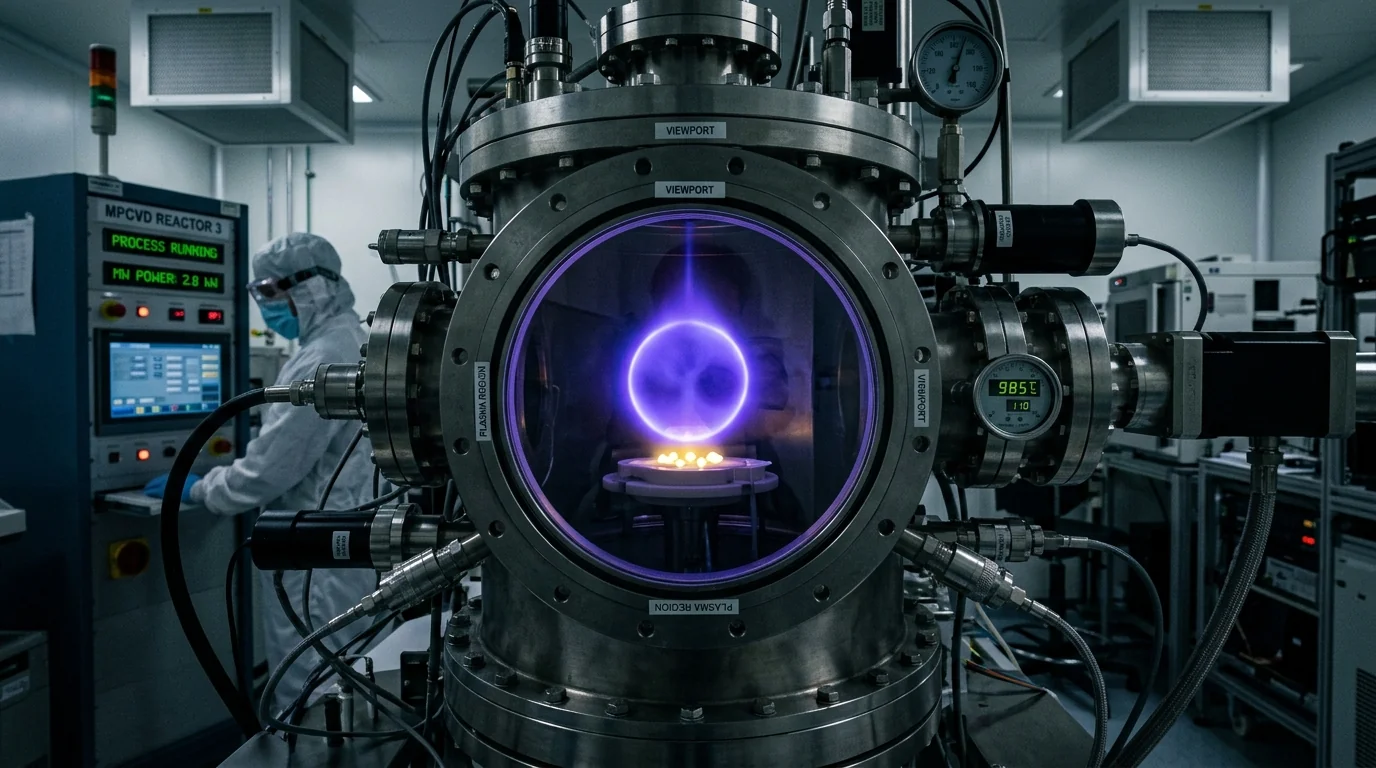
A thin wafer slice of pure Type IIa diamond is placed inside the reactor stage.
Chamber is evacuated to ultra-low pressure and flooded with methane (CH₄) and hydrogen (H₂).
High-intensity microwaves heat gases to 3,000°C, breaking molecular bonds into energized carbon radicals.
Carbon atoms precipitate onto the seed, replicating its diamond crystal lattice layer by atomic layer.
Forms a blocky, square rough diamond crystal ready for precision laser sawing and Surat polishing.
Superior control over chemical purity. CVD diamonds are almost universally Type IIa — the purest category that represents fewer than 2% of natural diamonds.
Grows vertically in a cubic tabular block, allowing Surat master cutters to achieve maximum yield for Square, Rectangular, and Round silhouettes.
Some CVD diamonds undergo optional mild HPHT annealing to relieve internal crystal strain and enhance icy colorlessness. Fully declared on reports.
Beyond the 4Cs, elite gemologists inspect the microscopic finish and optical geometry of every facet. The difference between an ordinary diamond and a breathtaking masterpiece lies in Polish, Symmetry, Proportions, and Fluorescence.
When white ambient light penetrates a master-faceted diamond, its internal mirrors split the beam. Brilliance is the intense return of pure white light. Fire is the spectral rainbow flash caused by prismatic dispersion (breaking light into reds, blues, and golds). Scintillation is the dynamic sparkle and dance of light and shadow as the diamond moves.
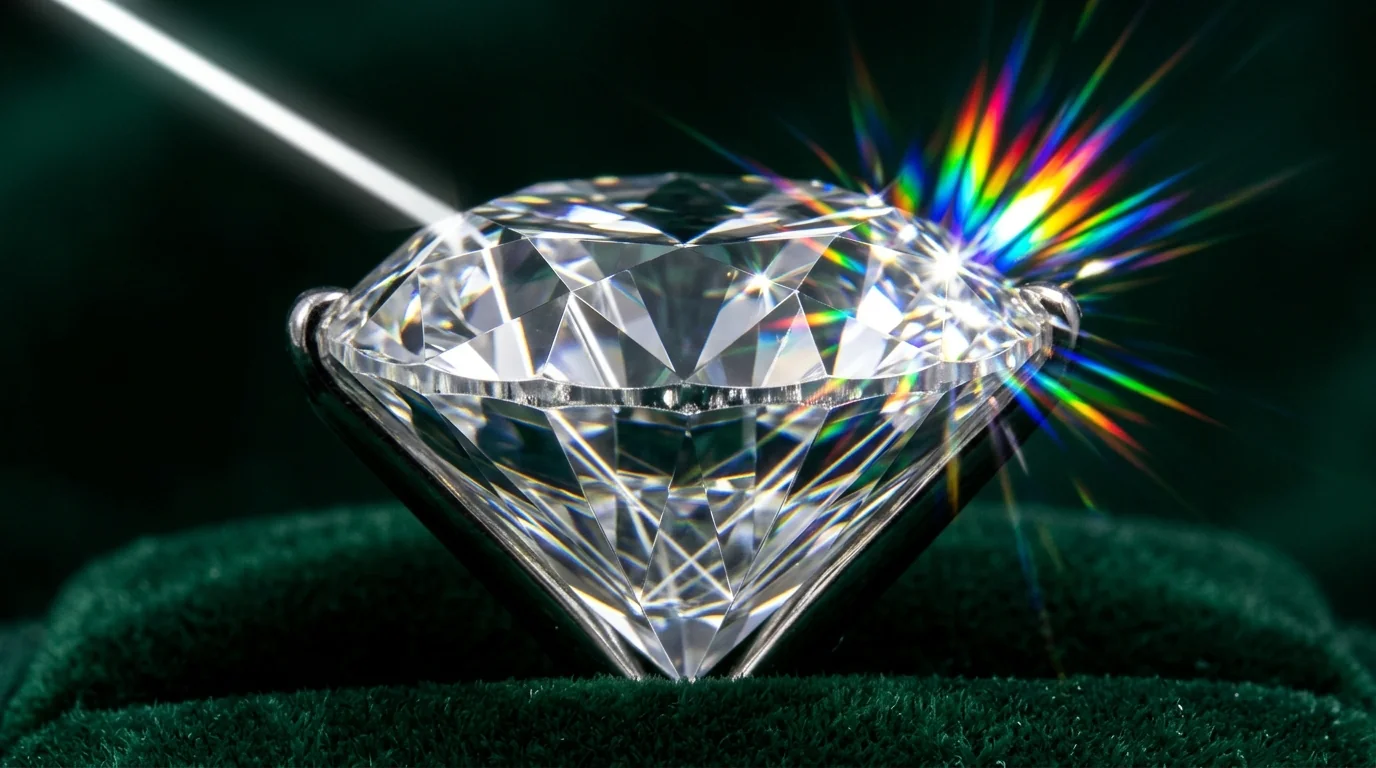
After a diamond is cut on cast-iron scaifes coated with olive oil and diamond powder, its facets undergo final polishing. Polish evaluates the overall smoothness of each facet surface under 10x magnification, checking for polishing wheel drag lines, pit marks, scratches, or burn marks.
Zero microscopic polish lines detectable under 10x loupe. Standard for all HIVA diamonds.
Extremely faint surface lines visible only under high magnification; zero visual loss to eye.
Noticeable polish lines or burn marks visible under loupe; can subtly soften luster.
Heavy wheel lines or haze. Not recommended for fine jewellery.
A diamond grading report from an internationally recognized laboratory (such as IGI or GIA) is the diamond’s official passport. Click on any field on the specimen certificate below to understand what each gemological term means and why it protects your purchase.
Scientific evaluation of light return, fire, scintillation, weight ratio, and facet symmetry.
The most important grade! Guarantees maximum sparkle, fire, and optical life.
Always insist on an independent laboratory report from recognized bodies like IGI or GIA. Never rely on an appraisal or seller card that lacks an internationally verifiable report number.
There is no single "best diamond" for everyone. The smartest purchase aligns with your unique personal priorities — whether that is maximizing blinding brilliance, achieving maximum finger presence, or getting the most value for your budget.
Follow this battle-tested roadmap from our master atelier to evaluate certifications, maximize face-up spread, and complete an informed purchase.
Decide whether your primary goal is maximum brilliance, maximum finger coverage, or high investment purity.
Select between ancient geological heritage (Natural) or technological efficiency with 2x–3x larger size (Lab-Grown).
Choose a shape that reflects personal style: classic Round, modern Princess, romantic Oval, or vintage Emerald.
Remember to consider millimeter diameter rather than just carat mass. Look for just-under milestone sizes.
Pair D–F with platinum/white gold; select G–J for sensational value in yellow or rose gold settings.
Avoid paying huge premiums for Flawless stones; VS1/VS2 clarity is completely clean to the naked eye.
Never compromise on cut quality. Cut is the sole engine that controls brilliance, fire, and light return.
Ensure your stone includes an internationally verifiable digital laboratory certificate with a matching laser inscription.
Check that Table % is 54–57% and Depth % is 61–62.5% to eliminate light leakage and watery centers.
Use HIVA Diamond's interactive 360° spin viewer to examine internal inclusions and check for bow-tie shadows in fancy shapes.
Ensure pointed tips (Pear, Marquise, Princess) feature protective V-prongs to safeguard against daily impacts.
Receive fully insured door-to-door worldwide shipping, laboratory certification, and lifetime diamond authenticity warranty.
While diamonds are the hardest physical mineral known to humankind (Mohs 10), they possess a natural affinity for grease and oils. Proper cleaning and mindful handling preserve their fiery brilliance for generations.
Diamonds naturally attract lipids from hand lotions, makeup, and cooking oils. Soak in warm water with a few drops of mild degreasing dish soap for 20 minutes, then brush gently beneath the setting with a soft-bristled brush.
Ultrasonic sound waves and pressurized steam remove deep-seated grime effectively. However, only use ultrasonics after confirming that prongs are snug and the diamond has no heavy surface-reaching feathers that sound waves could stress.
Over years of daily wear, delicate gold prongs can snag on fabrics or wear thin. A professional jeweler should inspect prong tightness every 6 to 12 months to prevent catastrophic stone loss.
Search our encyclopedia of technical gemological terminology, diamond anatomy definitions, cutting techniques, and laboratory classifications.
The total amount of white light reflected back to the eye from both internal mirrors and external facets of a polished diamond.
The flashes of vivid spectral rainbow colors (red, orange, blue, violet) produced by the prism-like dispersion of white light within the diamond.
The dynamic flashes of sparkling light and dark contrast seen when the diamond, light source, or observer moves.
The standard international metric unit of gemstone mass. Exactly equal to 200 milligrams (0.20 grams) or 100 points.
The relative freedom of a diamond from internal characteristics (inclusions) and surface irregularities (blemishes) evaluated under 10x magnification.
The evaluation of absence of body color in white diamonds, universally graded from D (completely colorless) to Z (light yellow or brown).
The geometric precision of a diamond's angles, proportions, symmetry, and polish. Cut directly determines how light is handled and how brightly the stone sparkles.
The flat octagonal uppermost facet at the top of the diamond crown; functions as the primary light entryway.
The upper section of the diamond extending from the table down to the girdle, consisting of 32 facets in a round brilliant.
The narrow outer rim separating the crown from the pavilion, serving as the setting edge secured by ring prongs.
The lower cone-shaped portion of the diamond beneath the girdle that reflects light back upward through the crown.
The microscopic facet or point at the bottom tip of the pavilion. An ideal culet is graded 'None' or 'Very Small' to eliminate dark centers.
The width of the table facet expressed as a percentage of the diamond's average girdle diameter (ideal: 54%–57%).
The total height of the diamond from table to culet expressed as a percentage of its average girdle diameter (ideal: 61.0%–62.5%).
The angle at which bezel facets intersect the girdle plane. An ideal crown angle of 34.0°–35.0° maximizes spectral rainbow fire.
The critical angle at which pavilion facets meet the girdle plane. An ideal 40.6°–41.0° ensures 100% total internal reflection.
The emission of visible light (typically soft blue) when a diamond is exposed to long-wave ultraviolet (UV) radiation.
An internal clarity characteristic enclosed within a diamond, such as a crystal pinpoint, feather fracture, or cloud.
A clarity irregularity confined entirely to the external surface of a polished stone, such as a polishing line, pit, or scratch.
The exactness of facet alignment, shape balance, and intersection points. Perfect symmetry produces 'Hearts and Arrows'.
The overall smoothness of a diamond's facet surfaces evaluated under 10x magnification.
A flat, polished plane on a diamond cut at precise angles to refract and reflect light.
An advanced method of diamond cultivation where carbon-rich plasma gas deposits carbon atoms onto a diamond seed plate in a vacuum chamber.
A diamond synthesis method using massive multi-anvil hydraulic presses to replicate Earth mantle conditions (60,000 atm, 1,500°C).
The most chemically pure diamond type known, containing virtually zero measurable nitrogen or boron. Represents <2% of natural diamonds and the majority of top-tier lab diamonds.
A gemological term describing a diamond whose inclusions cannot be seen by the unaided human eye from a viewing distance of 10–12 inches.
The world's largest independent gemological grading laboratory, globally renowned for its authoritative certification of certified loose diamonds.
The non-profit research institution that created the universal 4Cs grading system and the International Diamond Grading System™.
Europe's leading authority in diamond grading and certification, based in the global diamond capital of Antwerp, Belgium.
A handheld small magnification lens (standardized at 10x power) used by professional gemologists to grade clarity, cut, and polish.
A heavy cast-iron polishing wheel revolving at 3,000 RPM, charged with diamond powder and oil, used by Surat master artisans to facet diamonds.
The diamond industry is filled with outdated marketing conventions and common misconceptions. Here is the objective truth supported by modern gemological science.
Lab-grown diamonds are 100% real diamonds composed of pure crystallized carbon.
Cubic Zirconia (zirconium dioxide) and Moissanite (silicon carbide) are diamond stimulants with different chemistry and lower hardness. Lab diamonds have the exact same crystal lattice, refractive index (2.417), dispersion (0.044), and Mohs 10 hardness as mined diamonds.
Carat measures weight, not physical diameter. Cut proportions dictate visible face-up spread.
A poorly cut 1.10ct stone cut too deep hides its extra carat mass in a bulky pavilion, resulting in a face-up millimeter spread smaller than an Ideal Cut 1.00ct diamond. Proper proportions ensure you pay for visible size, not hidden bottom weight.
VS1 and VS2 diamonds are virtually 100% eye-clean and appear identical to Flawless stones.
Inclusions in VS1 and VS2 grades are microscopic and completely invisible without 10x laboratory magnification. Allocating budget toward an Excellent Cut and higher Carat delivers dramatically more visual impact than paying an extreme rarity premium for Flawless clarity.
Blue fluorescence can actually make near-colorless diamonds look whiter in natural sunlight.
In diamonds with faint warmth (G, H, I, J colors), medium to strong blue fluorescence naturally counteracts yellow undertones, making the diamond face up one to two grades whiter outdoors. It only causes haziness in fewer than 0.2% of high-color stones.
Because atomic properties are identical, traditional loupes and thermal testers cannot distinguish them.
Both natural and lab diamonds register as positive on thermal diamond pens. Laboratories identify them using laser inscription registry or photoluminescence spectroscopy machines that analyze microscopic trace element growth patterns.
Facet style fundamentally alters light return: brilliant cuts flash; step cuts reflect.
Round Brilliant, Oval, and Cushion cuts feature angled triangular and kite facets that maximize rapid fire and scintillation. In contrast, Emerald and Asscher cuts use parallel step facets that create an understated, elegant 'hall-of-mirrors' reflection.
Answers to the most common questions regarding diamond specifications, lab-grown science, certification standards, and bespoke ring customization.
Yes, 100%. A lab-grown diamond is a genuine diamond composed of pure crystallized carbon in a cubic crystal lattice. It shares identical chemical, physical, and optical properties with mined diamonds (Mohs hardness 10, refractive index 2.417). The US Federal Trade Commission (FTC), GIA, and IGI recognize lab-grown diamonds as real diamonds.
CVD (Chemical Vapour Deposition) grows diamonds in a vacuum chamber where carbon-rich plasma gas deposits carbon layer-by-layer onto a seed plate at lower pressure. HPHT (High Pressure High Temperature) uses massive mechanical hydraulic presses to replicate Earth mantle conditions (60,000 atmospheres and 1,500°C). Both methods produce 100% genuine Type IIa gemological diamonds.
Cut is universally recognized as the most critical C. Cut dictates how effectively light enters and bounces inside the diamond to reflect brilliance, fire, and scintillation back to your eyes. A stone with flawless clarity and colorless D grade will look dull and lifeless if poorly cut, while an Excellent Cut G/VS2 diamond will sparkle across an entire room.
A diamond is considered 'eye-clean' when its natural internal inclusions cannot be seen by an unaided human eye from a standard viewing distance of 10 to 12 inches under natural daylight. Grades VS1 and VS2 are virtually always 100% eye-clean, allowing buyers to avoid paying massive premiums for Flawless stones that look identical in daily wear.
Carat measures weight (mass), not physical surface dimensions. If a diamond is cut too deep, its extra carat weight is hidden in a thick pavilion beneath the girdle where no one can see it. If it is cut to ideal proportions, its millimeter spread is maximized across the top table, giving you the largest possible face-up appearance.
Fluorescence is the soft blue glow emitted by some diamonds when exposed to long-wave ultraviolet (UV) light. It is an identifying characteristic, not a defect. In diamonds with faint yellow tones (G, H, I, J), blue fluorescence actually acts as a visual filter that cancels out warmth, making the stone look one to two color grades whiter in outdoor daylight.
The two most authoritative independent gemological grading bodies in the world are the International Gemological Institute (IGI) and the Gemological Institute of America (GIA). All HIVA Diamond stones are independently graded by IGI or GIA, complete with a verifiable digital certificate and a micro-laser inscription on the diamond girdle matching the report number.
Every certified diamond has an official report number laser-inscribed on its girdle. You can visit the official IGI (igi.org) or GIA (gia.edu) website, navigate to 'Report Check', and enter the alphanumeric number to view the original digital grading report archived by the laboratory.
Because diamonds naturally attract grease and cosmetic oils, we recommend soaking your piece in warm water with mild degreasing liquid dish soap for 20 minutes every 2 to 3 weeks. Gently brush around prongs and beneath the pavilion with a soft-bristled baby toothbrush, rinse thoroughly under warm water (with the drain plugged!), and pat dry with a lint-free cloth.
Absolutely. HIVA Diamond operates its own direct manufacturing atelier in Surat, Gujarat. You can select any loose certified natural or lab-grown diamond from our live inventory and collaborate with our CAD design team to custom craft bespoke engagement rings, solitaire pendants, tennis bracelets, or earrings in 14k/18k Gold or Platinum.
Beyond the 4Cs, look at three key factors: (1) Cut Proportions (Table % between 54–57%, Depth % between 61–62.5%), (2) Polish & Symmetry grades (aim for Triple Excellent), and (3) 360° interactive high-definition spin video to inspect inclusion locations. Inclusions placed off to the side beneath crown facets are far better than a dark crystal dead-center on the table.
Every shipment from HIVA Diamond is dispatched via premier armored courier partners (e.g. Brink's, Malca-Amit, FedEx Secure) with 100% full transit insurance coverage until you physically sign for the package at your doorstep. We ship to over 70 countries worldwide.
Whether you need help decoding a laboratory grading report, comparing two stones on our live inventory, or designing a bespoke engagement ring from scratch, our gemologists are available for direct, one-on-one consultation.